ROC Compliance Calendar 2026-27: Due Dates & Fees
Updated on 20 November 2026. Due dates checked against MCA notifications and circulars issued up to 24 October 2026.
Every company registered in India has a fixed set of ROC filings each year, plus filings triggered by events such as a director change or a share allotment. This ROC compliance calendar lists every due date for FY 2026-27 month by month, explains who must file each form, and sets out the filing fees, late fees and penalties.
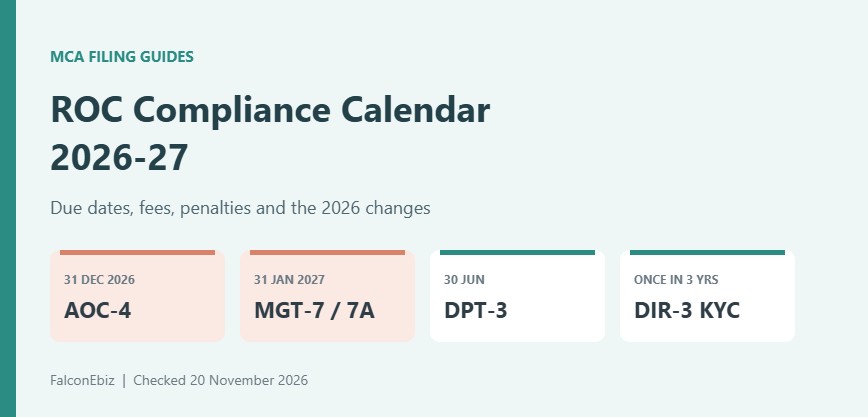
- For FY 2025-26 accounts, MCA has allowed AOC-4 to be filed without additional fees until 31 December 2026, and MGT-7 or MGT-7A until 31 January 2027 (General Circular 05/2026). The AGM deadline of 30 September 2026 was not extended.
- DIR-3 KYC is no longer annual. From 31 March 2026, each director files DIR-3 KYC Web once every three financial years, by 30 June, and within 30 days of any change in mobile number, email or address.
- Late AOC-4 and MGT-7 filings cost ₹100 per day per form in additional fees, with no upper limit, on top of any penalty under sections 92(5) and 137(3).
- Small companies are now those with paid-up capital up to ₹10 crore and turnover up to ₹100 crore (from 1 December 2025). More companies can now file the shorter MGT-7A and qualify for half penalties under section 446B.
Next ROC due dates
- 1 December 2025: small company limits raised to ₹10 crore paid-up capital and ₹100 crore turnover (G.S.R. 880(E)).
- 31 March 2026: DIR-3 KYC moves from annual to once every three financial years. DIR-3 KYC Web is now the only KYC form (G.S.R. 943(E)).
- 21 April 2026: DIR-3 KYC Web fees revised: nil on time, ₹5,000 if late or to reactivate a DIN, ₹500 for each update of personal details (G.S.R. 300(E)).
- 15 April to 15 September 2026: the Companies Compliance Facilitation Scheme (CCFS-2026) allowed pending annual filings at reduced additional fees. The scheme has closed.
- 24 October 2026: AOC-4 for FY 2025-26 allowed until 31 December 2026, and MGT-7/MGT-7A until 31 January 2027, without additional fees (General Circular 05/2026).
ROC due dates for FY 2026-27: month-by-month calendar
The dates below assume a company with a 31 March year-end that holds its AGM on the last permitted day, 30 September 2026. If your AGM was earlier, the AOC-4, MGT-7 and ADT-1 due dates fall earlier too, but the relaxed dates under General Circular 05/2026 still apply to FY 2025-26 filings.
Through the year: hold at least four board meetings, with no more than 120 days between two meetings (section 173). OPCs, small companies, dormant companies and Section 8 companies need only one meeting in each half of the calendar year, at least 90 days apart. Directors give their disclosure of interest (MBP-1) at the first board meeting of the financial year, and confirm in DIR-8 that they are not disqualified before they are appointed or re-appointed.
Annual ROC filings: AOC-4, MGT-7, ADT-1, DIR-3 KYC, DPT-3 and MSME-1
| Form | What it is | Who files | Statutory due date |
|---|---|---|---|
| AOC-4 | Financial statements, with the board's report and auditor's report | Every company | Within 30 days of the AGM; OPCs within 180 days of year-end |
| AOC-4 XBRL | Financial statements in XBRL format | Listed companies, their Indian subsidiaries, and companies with paid-up capital of ₹5 crore or more or turnover of ₹100 crore or more | As AOC-4 |
| AOC-4 CFS | Consolidated financial statements | Companies with subsidiaries, associates or joint ventures | As AOC-4 |
| MGT-7 | Annual return | Every company other than OPCs and small companies | Within 60 days of the AGM |
| MGT-7A | Shorter annual return | OPCs and small companies | Within 60 days of the AGM; OPCs within 60 days of 30 September |
| ADT-1 | Notice of auditor appointment | Company appointing or re-appointing its auditor | Within 15 days of the meeting that appoints the auditor |
| DIR-3 KYC Web | KYC of every DIN holder | Every individual holding a DIN | Once in three financial years, by 30 June; within 30 days of any change in mobile, email or address |
| DPT-3 | Return of deposits and transactions not treated as deposits | Every company other than government companies, banks, NBFCs and housing finance companies | 30 June, with figures as at 31 March |
| MSME-1 | Half-yearly return of dues to micro and small enterprises outstanding over 45 days | Companies with such dues | 31 October and 30 April |
| PAS-6 | Reconciliation of share capital audit report | Unlisted public companies | Within 60 days of each half-year end |
| LLP Form 11 | LLP annual return | Every LLP | 30 May |
| LLP Form 8 | Statement of account and solvency | Every LLP | 30 October |
Event-based ROC filings
These forms are not tied to the calendar. They fall due within a fixed time after an event.
| Event | Form | Time limit |
|---|---|---|
| Commencement of business after incorporation | INC-20A | Within 180 days of incorporation |
| Appointment, resignation or change in designation of a director or KMP | DIR-12 | Within 30 days of the change |
| Change of registered office | INC-22 | Within 30 days of the change |
| Increase in authorised capital | SH-7 | Within 30 days of the shareholders' resolution |
| Allotment of shares | PAS-3 | Within 15 days of allotment |
| Filing of specified board or special resolutions | MGT-14 | Within 30 days of the resolution |
| Creation or modification of a charge | CHG-1 | Within 30 days, extendable to 60 days with additional fees |
| Satisfaction of a charge | CHG-4 | Within 30 days of satisfaction |
| Declaration of significant beneficial ownership | BEN-2 | Within 30 days of receiving BEN-1 |
| Change in a director's mobile number, email or address | DIR-3 KYC Web | Within 30 days of the change, fee ₹500 |
| Application to strike off the company | STK-2 | When the company has ceased business; filings must be up to date |
ROC filing fees
The normal fee for most ROC forms depends on the company's authorised (nominal) share capital. DIR-3 KYC Web is free when filed on time.
| Nominal share capital | Fee per form |
|---|---|
| Less than ₹1 lakh | ₹200 |
| ₹1 lakh to less than ₹5 lakh | ₹300 |
| ₹5 lakh to less than ₹25 lakh | ₹400 |
| ₹25 lakh to less than ₹1 crore | ₹500 |
| ₹1 crore or more | ₹600 |
| Companies without share capital | ₹200 |
Late fees for AOC-4, MGT-7 and other ROC forms
A company that files both forms 90 days late pays ₹18,000 in additional fees.
Most other forms (including ADT-1, DIR-12, INC-22, MGT-14 and DPT-3) attract a multiple of the normal fee, depending on the delay:
| Delay | Additional fee |
|---|---|
| Up to 15 days (forms under sections 139 and 157 only) | 1 times the normal fee |
| Up to 30 days | 2 times |
| 31 to 60 days | 4 times |
| 61 to 90 days | 6 times |
| 91 to 180 days | 10 times |
| More than 180 days | 12 times |
For INC-22 and PAS-3, a higher additional fee (3 to 18 times the normal fee) applies where the company has filed late two or more times within 365 days. Charge forms (CHG-1, CHG-4) and SH-7 have separate fee scales.
DIR-3 KYC Web: ₹5,000 if filed late or to reactivate a deactivated DIN. Until it is filed, the DIN is deactivated and the director cannot sign company filings.
Penalties for not filing annual returns and financial statements
Additional fees are not penalties. The ROC can separately levy penalties through adjudication:
| Default | Company | Each officer in default |
|---|---|---|
| Annual return not filed (section 92(5)) | ₹10,000, plus ₹100 per day, up to ₹2 lakh | ₹10,000, plus ₹100 per day, up to ₹50,000 |
| Financial statements not filed (section 137(3)) | ₹10,000, plus ₹100 per day, up to ₹2 lakh | ₹10,000, plus ₹100 per day, up to ₹50,000 |
Under section 446B, OPCs, small companies, recognised start-ups and producer companies are liable to no more than half of these penalties, subject to a maximum of ₹2 lakh for the company and ₹1 lakh for an officer. The longer-term risks are larger. Under section 164(2), directors of a company that has not filed financial statements or annual returns for three continuous financial years are disqualified for five years. ROCs have also used prolonged non-filing to identify companies for strike-off under section 248.
How many companies fall behind on ROC filings?
Missed annual filings are common. Over 3.8 lakh companies listed as Active have no financial statements on record more recent than FY 2023-24, even though their records were rechecked after the FY 2024-25 filing deadline. Including companies not yet rechecked, the figure is about 4.07 lakh, or 31% of active companies with at least one year of financial statements on record.
Frequently asked questions
What is the last date to file AOC-4 for FY 2025-26?
The statutory due date is 30 days from the AGM, which is 30 October 2026 for an AGM held on 30 September. Under General Circular 05/2026, AOC-4 for FY 2025-26 can be filed without additional fees until 31 December 2026.
What is the due date for MGT-7 for FY 2025-26?
MGT-7 and MGT-7A are due within 60 days of the AGM, which is 29 November 2026 for an AGM on 30 September. MCA has allowed them to be filed without additional fees until 31 January 2027.
Does General Circular 05/2026 extend the AGM date?
No. The AGM for FY 2025-26 had to be held by 30 September 2026 unless the ROC granted an extension. The circular relaxes only additional fees for AOC-4 and MGT-7.
Is DIR-3 KYC required every year?
No. From 31 March 2026, every DIN holder files DIR-3 KYC Web once every three financial years, by 30 June. A director must also file it within 30 days of changing their mobile number, email or residential address, with a fee of ₹500.
What is the late fee for AOC-4 and MGT-7?
₹100 per day for each form, with no upper limit. Penalties under sections 92(5) and 137(3) can be levied separately.
FalconEbiz works with practising company secretary firms who can file your annual ROC forms and keep track of the due dates. We will connect you with a firm, which will then serve you independently. Write to us at support@falconebiz.com, or see the ROC Annual Compliance page.
Related reading
- Number of companies in India state-wise (2026 data)
- How to get a Company Search Report or RoC Search Report
Sources: Companies Act, 2013 and Rules; MCA General Circulars 01/2026, 03/2026, 04/2026 and 05/2026; G.S.R. 880(E), 943(E) and 300(E). Checked 20 November 2026. Source: FalconEbiz analysis of MCA company master data, snapshot dated 20 November 2026.